
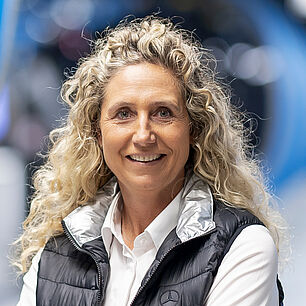
Sara Gielen
Head of production and manager Mercedes-Benz plant Sindelfingen
After successfully completing her engineering studies in production mechanics, Sara Gielen started her professional career in 1997 at the metalworking company Haesevoets n.v. in Herk de Stad, Belgium. In 2000, she moved to Ford Motor Company, where she successfully developed the concept of the Genk Industrial Park. Furthermore she was involved in the development of the industrial park in Cologne during this time. In 2002, she earned an Executive Master of Business Administration degree while working. After holding several leading positions in the areas of paint shop, production control and assembly, she took over the production management of vehicle assembly in Genk in 2012 and made a significant contribution to occupational safety, quality, cost management and work culture. In 2015, she was also assigned the division management of the entire assembly and from 2019 the division management of the bodyshop construction trades. In 2020, Sara Gielen successfully rolled out the "Lean & Digital" mindset transformation as deputy plant manager of the Ford plant in Cologne. From 2021 - 2023, she was responsible for the management of the Ford plant in Saarlouis with over 4,500 employees. In July 2024, she moved to Mercedes-Benz AG and has since served as site manager and head of production at the Sindelfingen plant.
[Keynote] Automotive Production in Transformation: Preserving Tradition – Shaping the Future
Existing for 110 years, the Mercedes-Benz plant in Sindelfingen is one of the most traditional vehicle plants of the brand with the star. With around 35.000 employees, the location is the region's largest and most important employer. To ensure that this remains the case, the plant is experiencing its greatest challenge to date – the transformation towards a fully electric driven future. In addition to vehicle production, the company's research and development department is located within the factory premises. Sindelfingen often takes a pioneering role in testing innovative technologies first in series production before their roll-out in the global production network. A radiant lighthouse for this pioneering role is Factory56, which opened in 2019 – the birthplace of the Mercedes-Benz S-Class, the Mercedes-Maybach S-Class and the all-electric EQS. Thanks to its technological standards, it is considered one of the most modern production facilities worldwide and is furthermore sustainably designed. Besides digitalization and sustainability, flexibility is the most important key to successful production of the future. In her keynote speech, plant manager Sara Gielen will show how the Sindelfingen plant plays a pioneering role for the entire industry without forgetting its traditions.

Mercedes-Benz AG at a glance
Mercedes-Benz AG is part of the Mercedes-Benz Group AG with a total of around 166,000 employees worldwide and is responsible for the global business of Mercedes-Benz Cars and Mercedes-Benz Vans. Ola Källenius is Chairman of the Board of Management of Mercedes-Benz AG. The company focuses on the development, production and sales of passenger cars, vans and vehicle-related services. Furthermore, the company aspires to be the leader in the fields of electric mobility and vehicle software. The product portfolio comprises the Mercedes-Benz brand with Mercedes-AMG, Mercedes-Maybach and G-Class with their all-electric models as well as products of the smart brand. Mercedes-Benz AG is one of the world's largest manufacturers of luxury passenger cars. In 2023 it sold around two million passenger cars and 447,800 vans. In its two business segments, Mercedes-Benz AG is continually expanding its worldwide production network with more than 30 production sites on four continents, while gearing itself to meet the requirements of electric mobility. At the same time, the company is constructing and extending its global battery production network on three continents. As sustainability is the guiding principle of the Mercedes-Benz strategy and for the company itself, this means creating lasting value for all stakeholders: for customers, employees, investors, business partners and society as a whole. The basis for this is the sustainable business strategy of the Mercedes-Benz Group. The company thus takes responsibility for the economic, ecological and social effects of its business activities and looks at the entire value chain.